
News & Events


NEWS September 23, 2025

Sharing Insights and Lessons Learned: Reflections from the First In-Person Meeting of the JLN-CSHS Collaborative in Morocco, São Tomé and Principe, and Senegal

JLN Network Manager

Authors: Amal Dahri, Codou Badiane Mane, Abdoulaye Diaw, Bekkaoui Hassane, Isaulina Barreto, Leonel Pontes, and Ilhame Ouansafi. Representatives from Morocco, São Tomé and Principe, and Senegal, accompanied by World Bank  staff in the country offices, attended the inaugural in-person meeting of the in Washington, DC USA from February 26-27, 2024. The meeting was attended by 20 countries from Africa, Asia, the Middle East, and South America, and was held to facilitate the sharing of experiences and lessons learned regarding climate change response and healthcare system resilience. The primary goals of the meeting were to initiate the collaborative, identify priority technical areas and key themes, share existing efforts, tools, and successes, understand and document expectations for collaborative activities, and jointly outline potential knowledge products that could be co-produced throughout the two-year collaborative period. Participants identified six workstreams for focus by the collaborative and agreed to collaboratively co-develop five knowledge products in 2024-2025 corresponding to the first three workstreams: 1) Governance, 2) Financing and Maximizing Financing, 3) Data and Accountability, 4) Multisectoral Action, 5) Engaging Communities, and 6) Service Delivery Models. Discussions revealed that the cost of inaction on climate change, whose global impact is already evident greatly surpasses the cost of investing in mitigation efforts. These investments would benefit healthcare systems, enabling them to continue serving populations, especially the most vulnerable. This article highlights the JLN CSHS collaborative’s discussions of Morocco, São Tomé and Príncipe, and Senegal’s climate and health situations, as well as their expectations for upcoming meetings and dedication to knowledge products. Climate and Health Landscape in Morocco, São Tomé and Príncipe, and Senegal Morocco, São Tomé and Príncipe, and Senegal acknowledge the significant impact climate change has on health outcomes, recognizing that it threatens to undermine decades of progress in public health. While these countries are at different stages of incorporating climate considerations into public policy, all three have demonstrated a political commitment to addressing climate change. Morocco’s CSHS Mitigation: Building Resilience to Climate Change Morocco faces growing challenges from climate change, experiencing extreme heat waves, drought, and flooding. The nation remains committed to international climate goals for 2030 and is taking decisive action to mitigate climate change and reduce greenhouse gas (GHG) emissions across all sectors, especially healthcare. By 2021, Morocco’s Ministry of Health and Social Protection had committed to building a sustainable and climate-resilient healthcare system. A recent assessment evaluated the environmental sustainability, climate resilience, and GHG emissions of Morocco’s public healthcare facilities. Based on the assessment’s recommendations, Morocco will develop an implementation plan to enhance the climate resilience of its healthcare facilities. These substantial measures demonstrate Morocco’s dedication to strengthening its healthcare system against climate change impacts and ensuring continued healthcare services amid climate-related disruptions. São Tomé and Príncipe, a small island developing state (SIDS), has a history of rainfall and landslides, which lead to water-borne diseases and increased cases of malaria and dengue fever. Necrotizing cellulitis, caused by microorganisms normally found on the skin, could also be linked to climate change. The northern part of the country, prone to flooding during the rainy season, has implemented simulation exercises to prepare for such events. Despite participating in the Conference of the Parties (COP), the country has not yet initiated health-related measures to adapt to climate change. Senegal’s Proactive Approach to Integrating Climate Risks in Health Sector Planning Senegal is taking a proactive stance against climate-related health risks by integrating climate considerations into the planning and budgeting of investment projects across all sectors, with a particular focus on health and health determinants. This approach is driven by the increased prevalence of extreme weather events such as heavy rainfall, flooding, extreme temperatures, unseasonal rainfall, dust storms, drought, and coastal erosion, which have led to the emergence of diseases like dengue fever in recent years (2017-2023). Key initiatives include strengthening the institutional framework and fostering intra- and multi-sectoral collaboration, particularly within the Health and Environment group, to ensure a comprehensive understanding and integration of climate risks in the health sector. Senegal demonstrates its commitment to climate-conscious healthcare through several initiatives. Collaboration between the Ministry of the Environment, Sustainable Development and Ecological Transition (MEDDTE) and the Ministry of Health and Social Action (MSAS) led to the development of the national adaptation plan for the health sector (PNAS), awaiting political validation. Further, a decree mandates climate integration in all future public investment projects exceeding 500 million FCFA, and a “green national budget” will complement the 2024 finance law. Senegal has completed gap analyses and vulnerability studies to inform these policies. The country is finalizing a concept note for a health adaptation project for the Green Climate Fund (GCF) and has integrated climate risk into health sector development policy, system structures, and procedures. Climate-sensitive health indicators are now part of the Nationally Determined Contribution (NDC) and routine health information system monitoring. Additionally, the heat wave early warning system is being strengthened. Country Learnings and Meeting Expectations International Collaboration to Build Climate-Resilient Healthcare Systems The inaugural in-person meeting of the JLN-CSHS partnership fostered a valuable exchange among French-speaking participants from diverse countries. The meeting facilitated a platform to share insights on climate change impacts, discuss region-specific challenges, and learn from each other’s progress in developing healthcare systems that can withstand climate change. Morocco, São Tomé and Príncipe, and Senegal valued the JLN knowledge exchange platform, which allowed them to expand their knowledge base and learn from the diverse approaches other countries have taken to address their unique challenges and constraints. The three countries were particularly interested in learning about initiatives undertaken by other participating countries to adapt and mitigate the adverse effects of climate change on health systems. They emphasized the importance of learning from good practices and successful initiatives in other contexts, with the goal of adapting and replicating these strategies within their own health systems. The three countries highlighted a number of specific features they learned from these meetings, at various stages of integrating climate change considerations into their public policies. Morocco emphasized that governance is the most important
NEWS

Second In-Person Meeting of the CSHS Collaborative

JLN Network Manager

Event Announcement The Second In-Person Meeting of the CSHS Collaborative October 5-9, Manama, Bahrain The JLN Collaborative on Climate Smart Health Systems will hold its second full-collaborative in-person meeting in Manama, Bahrain, from October 5-9, 2025. At the Second In-Person meeting, members will provide feedback and finalize the knowledge products that have been developed over the previous year (under the three workstreams of Governance, Financing, and Data and Accountability) and identify products for co-production in Year 2 of the collaborative, under the remaining three workstreams of Multisectoral Action, Engaging Communities, and Service Delivery Models. The Governance workstream has developed a Climate and Health Governance Guideline that covers policies, regulations, leadership, and stakeholder coordination. The Financing workstream has drafted two knowledge products: Making the Case for Investment in Climate and Health, which outlines key messages on health impacts and investment benefits, and a Repository on Public Financial Management for Climate and Health that compiles resources for climate-smart health financing. The Data and Accountability workstream has drafted a Data Toolkit on common data integration and visualization challenges, as well as two repositories, with the first focusing on Health Facility Infrastructure and the second focusing on Health Worker Tools. By fostering collaboration and knowledge exchange among policymakers, the CSHS Collaborative aims to strengthen governments’ capacity to build climate-smart health systems and address the challenges posed by climate change.  Members of the collaborative have previously convened at the Launch meeting of the collaborative in February 2024 (Washington, DC, USA) and at the First Author’s Workshop in October 2024 (New Delhi, India). The inaugural in-person meeting was attended by 20 countries from Africa, Asia, the Middle East, and South America. The primary goals of the initial in-person meeting of the JLN CSHS Collaborative were to initiate the collaborative, identify priority technical areas and key themes, share existing efforts, tools, and successes, understand and document expectations for collaborative activities, and jointly outline potential knowledge products that could be co-produced throughout the two-year collaborative period. The meeting facilitated the sharing of experiences and lessons learned regarding climate change response and healthcare system resilience. During the launch meeting, participants identified the six workstreams for focus by the collaborative and agreed to collaboratively co-develop knowledge products in 2024-2025 under the first three workstreams of Governance, Financing and Data and Accountability. The First Author’s Workshop in New Delhi, India, from October 7-11, 2024, brought together a select group of participants from 21 member countries to share their practical experiences and implementation knowledge. Attendees discussed the key components and country examples for inclusion in the Year 1 knowledge products and shared their interest in co-authoring and contributing content for specific sections in each knowledge product. The workshop concluded with working outlines for the knowledge products for further virtual deliberation.

NEWS September 15, 2025

From Fragmentation to Focus: Leveraging Strategic Health Purchasing Amid Conflict and Crisis

JLN Network Manager

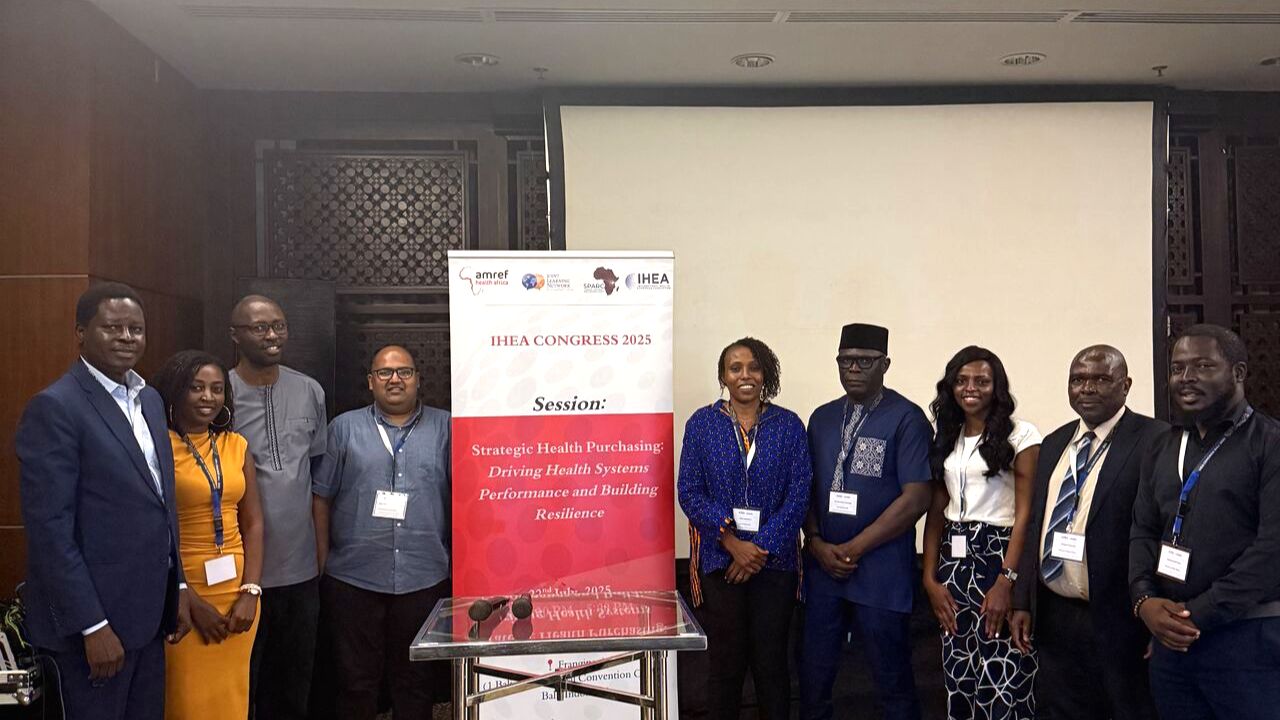
Africa faces a persistent challenge in financing healthcare, often characterised by limited public spending, high out-of-pocket payments, low domestic funding, and fragmented donor and funding flows. To tackle these challenges, countries are turning to Strategic Health Purchasing (SHP)—a smarter approach to delivering better health outcomes for every dollar spent, ensuring more equitable and accountable use of both domestic and donor resources. “Strategic Health Purchasing can improve how a health system uses information on population health needs and provider performance to more effectively allocate resources to health providers—even in fragile settings.” – Boniface Mbuthia, Technical Director, Health Financing, Amref Health Africa During the recent International Health Economics Association (IHEA) Congress, Joint Learning Network, Amref Health Africa and government representatives from Malawi, South Sudan, and Zambia discussed how SHP is being applied in different country contexts to identify, prioritise, and track health system strengthening opportunities and activities that accelerate Universal Health Coverage (UHC). Speakers also shared how they used the SHP Progress Tracking Framework, developed by the Strategic Purchasing Africa Resource Centre (SPARC), to map purchasing functions across health systems and financing schemes. The framework helps countries gain a clear picture of their current capabilities and gaps in key areas related to SHP, including governance arrangements, policy and legal frameworks, and purchasing functions. To date, policymakers in more than 20 countries across Africa and Asia have used the framework to guide their health financing reforms. Here are four key learnings from the session: 1. Harness Pooled Funding Mechanisms Pooled funds, including those from donors, create opportunities to purchase health services more strategically and sustainably—even in fragile states. South Sudan’s Health Sector Transformation Project (HSTP) is a powerful example, providing significant opportunities for enhancing provider-purchaser engagement, performance monitoring, contracting, and reforming provider payments. “Pooled health funds provide the financial resources, while strategic purchasing provides the mechanism to effectively and efficiently use those resources while aligning them to broader health goals,” Dr. John Rumunu, Director General of Health Policy Planning, Budgeting, and Research, South Sudan Ministry of Health. In Malawi, the Health Sector Strategic Plan III (2023-2030) is being used to advance “one plan, one budget” policy reforms to consolidate health resource flows and encourage the use of service level agreements (SLAs) currently for faith-based facilities. 2. Build Responsive Health Systems Through Strong Governance Strong governance emerges as the foundation that makes strategic health purchasing work in practice. Zambia is navigating ambitious reforms that include strengthening the National Health Insurance Scheme and transferring health system governance to local District Councils under the Ministry of Local Government. While complex, these reforms present an opportunity to reimagine how different purchasing entities can work together to increase utilisation, equity, financial protection, and quality care. In South Sudan, the Ministry of Health chairs the HSTP, creating a platform where donor funding, government priorities, and health system strengthening align. This governance structure doesn’t just manage resources—it offers an opportunity to build sustainable institutional capacity. 3. Contract with Health Facilities When health facilities have more control over their finances and operations and clear performance-based agreements, they deliver better care, respond more efficiently to the needs of their communities, and achieve better health performance with purchasing agencies. In Malawi, faith-based health facilities partner with the government through the Christian Health Association of Malawi or CHAM. They receive direct funding and operate with greater independence, enabling more responsive care. “Lessons from the use of SLAs for faith-based facilities are essential to guide further reforms on how we purchase health services—even from public facilities,” says Gladstone Mchoma, Health Economist with Malawi’s Ministry of Health. Zambia is using the National Health Insurance Management Authority to formally contract with private providers, providing a mechanism to specify service scope, pricing, and quality standards. 4. Connect Performance Data to Funding Decisions Countries across Africa collect vast amounts of health data, but this information doesn’t always influence how funding is allocated. Closing this gap is essential for strategic purchasing to work effectively. To address this, countries can redesign their processes so that performance information motivates purchasing decisions. This means rewarding facilities that deliver quality care efficiently while providing support to those who are struggling. While Zambia has a complex system for tracking health services and managing finances, district officials report that the data don’t always translate into financial decisions and that funds often flow regardless of performance. Local capacity and authority to make evidence-based decisions are crucial for making strategic purchasing work in practice. Dr. Chrispine Sichome, Director of Health Policy for Zambia’s Ministry of Health, emphasised that “tackling these challenges will not only accelerate progress toward UHC but also provide valuable insights for other low- and middle-income countries pursuing similar health financing reforms.” The Way Forward The learnings gathered from these three countries show that SHP can be used to strengthen even constrained health systems, and tools like the SHP Progress Tracking Framework provide a way to move beyond good intentions to measurable progress. Strategic health purchasing represents not just a financing reform, but a comprehensive approach to get better health outcomes for every person and every dollar spent. ———————— These lessons were originally shared at the International Health Economics Association 2025 Congress in Bali, Indonesia (July 19-23, 2025). The authors would like to thank Hallie Goertz for her strategic communications support. Authors: Rahul Kadarpeta, Boniface Mbuthia, Gladstone Mchoma, Frida Ngalesoni, Lizah Nyambura, John Rumunu, Chrispine Sichome Read also here: Amref Newsroom

NEWS August 21, 2025

In-Person Workshop, Istanbul-Primary Healthcare Performance Management Collaborative

JLN Network Manager

The JLN Primary Healthcare Performance Management Collaborative, facilitated by Aceso Global, held an in-person workshop from July 21–24, 2025, in Istanbul, Turkey. This highly interactive convening brought together member country teams to strengthen skills, co-create practical tools, and advance innovations in PHC performance management. The workshop centred on two key work-streams: Hard Skills Capacity-Building (Days 1 and 3): Participants worked on finalizing pilot initiatives in Liberia, South Africa, and the Philippines, focusing on practicum development, mini-project preparation, applied computer literacy, drafting terms of reference, contracting trainers, curriculum walkthroughs, and quantitative analysis. The sessions were designed to be hands-on, combining technical content with interactive learning activities to strengthen district-level management capacity. Dashboard Development (Days 2 and 4): Country teams engaged in data visualization exercises, group presentations, and practical discussions on effective dashboard use. Highlights included country updates from Mongolia and Nigeria, a masterclass on dashboard design and impact by expert Katherine Rowell, and a collaborative session supporting Mongolia’s development of a new in-house performance dashboard. The four-day workshop concluded with a planning session to shape the Collaborative’s final outputs, ensuring that lessons, tools, and resources are captured for use across JLN countries. This gathering not only deepened technical skills but also reinforced the value of peer learning—helping member countries strengthen the foundations of resilient and equitable primary healthcare systems.

NEWS August 14, 2025

CCG Newsletter Spotlight: Dr. Kurudeven Tamil Chelvan, CCG Coordinator, Malaysia

JLN Network Manager

We are delighted to shine a spotlight on Dr. Kurudeven Tamil Chelvan, a pivotal member of the JLN Country Core Group (CCG) Coordinator Team for Malaysia. Dr. Chelvan’s dedication to healthcare reform and his insightful contributions have significantly strengthened Malaysia’s engagement with global knowledge and local practice. A Journey Rooted in Service and Vision  Dr. Chelvan currently serves as a dental officer at the Health Transformation Office (HTO), Ministry of Health Malaysia, building on invaluable experiences from the National Health Financing Section and frontline service in the Pahang State Health Department. These early experiences provided him with a profound understanding of the challenges faced by healthcare implementers and underserved communities. His passion has evolved towards health policy, behavioural change, and enhancing healthcare access for marginalized populations. Dr. Chelvan firmly believes in the power of strategic reform to build a more inclusive, equitable, and sustainable healthcare system. His current national-level work consistently deepens his understanding of the critical interplay between planning, policy implementation, and system transformation. Beyond his professional life, Dr. Chelvan finds rejuvenation in nature, whether hiking or exploring quiet trails. He also possesses a creative flair, drawn to music, visual storytelling, and design. He views the arts not only as a refreshing pursuit but also as a means to cultivate empathy and critical thinking—qualities he deems essential for both healthcare quality improvement and public policy. Bridging Global Insights with Local Practice as a JLN Institutional Coordinator  As a CCG Coordinator for Malaysia, Dr. Chelvan plays a crucial role in facilitating internal discussions for new collaboratives, cross-divisional meetings, and technical engagement sessions. He is also instrumental in disseminating JLN knowledge products to a wider audience through internal platforms and the Ministry’s postmaster system, enhancing awareness among healthcare personnel nationwide. This coordination role effectively positions him as a vital link between global knowledge and local application, ensuring that valuable insights are not just shared, but meaningfully applied to Malaysia’s health priorities. Key Lessons in Driving Meaningful Reform  Dr. Chelvan emphasizes that meaningful reform necessitates both strategic direction and operational flexibility. He highlights that effective change is driven by strong leadership commitment coupled with the empowerment of implementation-level officers to experiment, adapt, and reflect. His team has found that integrating peer learning and cross-country experiences into local contexts is most impactful when diverse perspectives are engaged early, procedural rigidity is reduced, and open channels for dialogue across units are maintained. A Memorable Highlight: Enhancing Visibility and Engagement  A significant achievement for Dr. Chelvan was the successful enhancement of internal visibility for the JLN knowledge platform. By strategically promoting resources during key planning periods and sharing them via the Ministry’s internal communications, there was a notable increase in interest and engagement across divisions. This experience underscored the power of structured dissemination in fostering broader institutional uptake. It also reinforced his conviction that achieving person-centred care requires integrating often-overlooked areas, such as oral health, into broader health system reforms. Despite the challenge of balancing competing operational priorities, Dr. Chelvan’s steady coordination and receptiveness to feedback have successfully maintained momentum and promoted the enduring value of collective learning. Thank you for your dedication, expertise, and advocacy, Dr. Chelvan! Your work is making a significant impact on global health security.