Jerry La Forgia, Jonty Roland, Mariam Hamza, Brendan Lawler
The Joint Learning Network on UHC (JLN) has been at the forefront of new learning modalities among health leaders since its establishment over 15 years ago – one of the first networks dedicated to south-south, peer-to-peer learning in the health sector at scale.
Such approaches have become commonplace today, but frequently struggle to demonstrate the exact pathway between learning activities and real-world impact. Funders understandably look at investments in conferences, webinars and workshops and ask ‘so what?’. This gap between knowledge and outcomes has prompted renewed interest in learning models that can more tangibly show results, but where implementation becomes the sole focus then activities often become closer to consulting projects, losing the learning benefits to the wider group along the way. So how to get the best of both worlds?
In the past few years, the JLN has been experimenting with many different ‘learn by doing’ methods in a bid to expand beyond its traditional modus operandi of co-producing (excellent) knowledge products and best practice resources in peer-to-peer learning collaboratives. As one of the main technical facilitators for JLN activities over this period, Aceso Global has been developing an approach called ‘implementation learning’, and has just completed its largest attempt at realizing this to date.
Building the Foundations
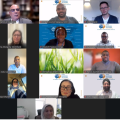
Starting in 2024, 35 primary health care managers and leaders from 13 countries came together to focus on how to improve performance management of their primary care systems, and were enthusiastic about adopting this implementation learning approach. Over the subsequent 24 months, Aceso Global facilitated the collaborative with one central idea in mind: instead of learning about best practices, the group would learn by developing knowledge products together and actually using them in their own systems.
The collaborative began with a scoping phase. Participants shared their biggest challenges in improving PHC performance management – things like supervisors without the necessary skills, deficient data systems and misaligned incentives – as well as the successes and strengths they had to offer.
Next the group started meeting regularly online to complete a six-month foundational learning phase: levelling-up understanding across participants through engagement with experts and each other in a key challenge area, sharing what they had learned and done. This helped establish a common baseline of knowledge, emphasizing that everyone had something to teach and something to learn.
From Theory to Practice
With this baseline built the collaborative began the implementation learning proper. Each country put forward a proposal for a project or improvement that they were ready to start work on right away. A subset of these was then chosen based on feasibility and alignment with the wider group’s interests. The participants then met for the first time to flesh out what needed to be done to support these projects, how they could each help, and what their own learning goals from the process would be. The goal was for ‘implementer countries’ to receive the practical support they needed from their peers in ‘accompanying countries’, while the latter would benefit from these ‘living case studies’ as they contributed to their work.
Three countries — Liberia, the Philippines, and South Africa — took on the ambitious task of designing and rolling out training programs to build PHC managers’ analytical and management skills. A fourth country, Mongolia, tackled a different challenge: redesigning its primary health care dashboard. These four “implementer countries” became the living laboratories for the entire collaborative. They would receive a year of focused support from the group to achieve their goals, while their messy, real-world process of launching these initiatives would become as much a part of the learning for participants as the final knowledge products.
What did this approach produce? Three things. First, the implementer countries didn’t just learn — they generated real, measurable results that they shared back with all 35 participants. Second, the knowledge products they created became global public goods — skill assessment instruments, trainable curricula and practical toolkits that other countries can now adapt to their own settings. And third, the accompanying (non-implementer) countries learned something that no case study could teach: what actually happens when you try to roll something out in a real health system, with all its constraints.
What Actually Changed: The Results
The collaborative produced substantial learning gains across the group. Prior to the collaborative, approximately one in three participants rated themselves either “quite” or “extremely” knowledgeable in PHC performance management; by the close of the collaborative, nearly 90 percent reported this level of knowledge and confidence. Importantly, these gains were not concentrated among implementer countries – in fact, there was no statistically significant difference in knowledge and confidence improvements between implementer and non-implementer country participants.
And impact was also measured on the ground in implementer countries. For the three countries that launched skill-building programs, for example, substantial gains in skills were seen among the PHC supervisors in pilot districts that received the training. And this was then extended into frontline services as well. In Liberia, for example, one team of trainees used the Plan–Do–Study–Act cycle to tackle long patient waiting times at a health center, cutting them from 90 to 55 minutes and lifting patient satisfaction scores by more than a quarter. The training program pilots in Liberia and the Philippines proved successful enough that both countries have since secured national funding to scale them up.
What Worked: Success Factors for Peer-to Peer Implementation Learning Approaches
Aceso Global documented a long list of lessons from this process to inform future JLN activities, but among the most important factors behind the success of this initiative were:
Real Practitioners as Participants: The entry criteria for this collaborative were strict: participants had to be real practitioners dealing with PHC performance management on a national or sub-national level. This meant everyone had the scope to implement within their role, and firsthand experience to contribute.
Small, timely financial support: The countries that made the most progress in this collaborative were the ones that received a small pot of pilot funding from the JLN’s new Joint Learning Fund. While many could afford this work themselves, the time that would have been lost to budget approvals and other delays without this would have meant many were only ready to implement after the collaborative had ended.
Understanding the nature of implementation: Implementation rarely follows a straight line. Even well-designed initiatives can stall unexpectedly; held up by contracting delays, missing authorizations, supply chain issues and coordination hurdles. Collaborative participants were no strangers to these experiences. The group shared them openly, turning potential setbacks into valuable learning on implementation processes, and ultimately contributing to impacts.
Keep the non-implementers engaged: As well as a plan to support the progress of the implementer countries, facilitators also needed to plan for what’s in it for the accompanying countries. There are many motivations that help to keep momentum going: many have particular areas they want to learn about for their own benefit, or particular expertise that they are keen to share. Personal relationships play a huge role too – a strong group dynamic is essential for participants to take time out of their busy roles in order to assist their peers.
The collaborative officially concluded in April 2026, but the work is far from over. The tools and training curricula developed are available on the JLN website where you can also watch videos of the participants talking you through the major elements of implementation.
Aceso Global would like to thank the Joint Learning Network on Universal Health Coverage and the Gates Foundation for their financial and technical support throughout this project, as well as our wonderful group of participants.