1. Home
  2. Blog
Blog, PHC

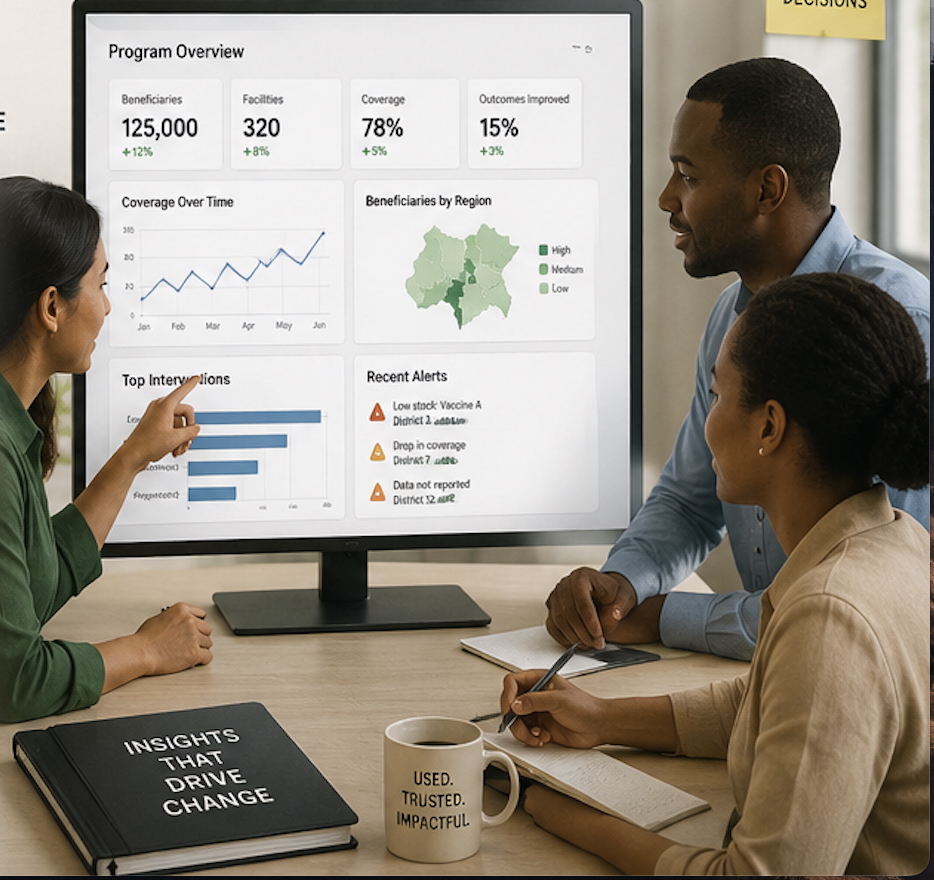
How to stop building dashboards nobody uses

Lurking on a server somewhere in your primary care system right now is a dashboard. It likely took months to build, contains data with the potential to improve essential healthcare nationwide, and – unless you’re in a minority – you either hate it, only use it when you have to, or don’t even know it exists.

Blog

More health for the money: Navigating the ins and outs of contracting of health services together

With the donor funding reductions and challenging economic times, many countries have found themselves in a challenging situation on what gets funded and how to finance their health system. Mobilizing additional domestic funding for health in Low- and Middle-Income Countries (LMICs) is challenged by highly informal economies, narrow tax bases, which constrains revenue collection, increasing debt, and limited fiscal space. Almost all LMICs are strategizing how to close funding gaps caused by reduced funding for health and how strategic purchasing approaches such as government-led contracting with the private sector can play an important role by offsetting challenges and augmenting both service delivery and financing in LMICs. Contracting has the potential to make the health system more efficient through delivering better value (higher quality care at lower or more efficient costs) achieving more health for the money.

Blog

How India and Egypt are building resilient pharmaceutical ecosystems

 Access to quality, affordable, and timely health products is fundamental to achieving Universal Health Coverage (UHC). Yet across many low- and middle-income countries (LMICs), pharmaceutical systems remain vulnerable to regulatory fragmentation, import dependency, supply chain disruptions and limited local manufacturing capacity - weaknesses that became even more visible during the COVID-19 pandemic and subsequent global supply disruption. 

Blog

Government Led-Contracting as a Critical Response to Changing Health Financing Landscape

The global health landscape is not merely shifting - it has fractured. The much anticipated “2026 Funding Cliff” has arrived, bringing with it a sharp retrenchment in development assistance for health. Between 2024 and 2025 alone, global aid flows declined by 21 percent, driven largely by a dramatic contraction in major bilateral financing. A recent analysis published in The Lancet Global Health warns that such abrupt reductions risk millions of preventable deaths by 2030, threatening to undo two decades of hard-won progress in controlling infectious diseases.

Blog, Global

Adapting to the Aid Transition: South–South  Collaboration and Catalytic Investment in a Fragmented World

As traditional development aid declines sharply—with cuts exceeding 70% from major donors between 2021 and 2025—African and Asian countries are navigating an unprecedented transition that demands new approaches to achieving universal health coverage. This article examines how South-South collaboration and catalytic investment mechanisms are emerging as critical strategies for sustaining health system progress in the post-aid era. Drawing on global experiences, including from the Joint Learning Network for Universal Health Coverage (JLN) and its Joint Learning Fund (JLF), we share how countries are leveraging peer-to-peer learning to mobilize domestic resources, and innovative financing to build resilient, country-owned health systems that limit the dependence on unpredictable flows of external assistance.

Blog, Global

Igniting Collective Power: Launching the CCG Community of Practice for Universal Health Coverage

The journey toward Universal Health Coverage (UHC) is rarely linear—it’s a shared path shaped by collaboration, resilience, and mutual learning. With the virtual launch of the Country Core Group (CCG) Community of Practice (CoP), the Joint Learning Network for Universal Health Coverage (JLN) introduced a dynamic new platform to unite countries in their collective pursuit of health for all.Global health leaders from across the JLN came together for the launch, driven by a common goal: to transform shared learning into stronger, more equitable health systems. The CCG CoP is not just a new initiative but the beginning of a vibrant movement, where we are attempting to redefine how we learn, collaborate, and take action for universal health coverage.”

Blog, Global

From Ideas to Action: Accelerating Health Systems Change with the Joint Learning Fund

At the heart of the Joint Learning Network (JLN), a global peer-based organization made up of policymakers and practitioners from 41-member countries, lies a shared commitment to collaborative learning and collective problem solving to advance Universal Health Coverage (UHC).  Through the JLN, in-country stakeholder groups made up of representatives from key government institutions and development partners working together on UHC reforms, come together to define and communicate country priorities, as well as share and apply learnings and guidance. Over the past few years, the CCGs became increasingly aware that more was needed to translate the knowledge acquired from JLN activities into action to address emerging health system challenges. In January 2025, the Joint Learning Fund (JLF) was launched to bridge the critical gap between collaborative learning and implementation. The purpose of the JLF is simple yet catalytic: support countries in translating joint learning guidance and resources into tangible action that strengthens health systems.

Blog, Country

Partage d’idées et d’enseignements tirés : réflexions issues de la première réunion en personne du JLN-CSHS au Maroc, à à São Tomé-et-Príncipe et au Sénégal

Des représentants du Maroc, de São Tomé-et-Principe et du Sénégal, accompagnés par des membres du personnel de la Banque mondiale chargés de l'  dans les bureaux nationaux , ont participé à la première réunion en présentiel du à Washington, DC, États-Unis, les 26 et 27 février 2024. La réunion a rassemblé 20 pays d'Afrique, d'Asie, du Moyen-Orient et d'Amérique du Sud et avait pour objectif de faciliter le partage d'expériences et d'enseignements tirés en matière de réponse au changement climatique et de résilience des systèmes de santé. Les principaux objectifs de la réunion étaient de lancer le partenariat, d'identifier les domaines techniques prioritaires et les thèmes clés, de partager les efforts, les outils et les réussites existants, de comprendre et de documenter les attentes en matière d'activités collaboratives, et de définir conjointement les produits de connaissance potentiels qui pourraient être coproduits au cours de la période de collaboration de deux ans. Les participants ont identifié six axes de travail sur lesquels la collaboration devait se concentrer et ont convenu de développer conjointement cinq produits de connaissance en 2024-2025 correspondant aux trois premiers axes de travail : 1) Gouvernance, 2) Financement et optimisation du financement, 3) Données et responsabilité, 4) Action multisectorielle, 5) Engagement des communautés et 6) Modèles de prestation de services.

Blog, Country

Compartir ideas y lecciones aprendidas: Reflexiones de la primera reunión presencial de la Colaboración JLN-CSHS en Marruecos, Santo Tomé y Príncipe y Senegal

Representantes de Marruecos, Santo Tomé y Príncipe y Senegal, acompañados por miembros del personal del Banco Mundial de la red en las oficinas nacionales y , asistieron a la reunión presencial inaugural de la en Washington D. C. (EE. UU.) los días 26 y 27 de febrero de 2024. A la reunión asistieron 20 países de África, Asia, Oriente Medio y Sudamérica, y se celebró con el fin de facilitar el intercambio de experiencias y lecciones aprendidas en relación con la respuesta al cambio climático y la resiliencia de los sistemas de salud. Los objetivos principales de la reunión eran iniciar la colaboración, identificar las áreas técnicas prioritarias y los temas clave, compartir los esfuerzos, las herramientas y los éxitos existentes, comprender y documentar las expectativas de las actividades de colaboración, y esbozar conjuntamente los posibles productos de conocimiento que podrían coproducirse a lo largo del periodo de colaboración de dos años. Los participantes identificaron seis líneas de trabajo en las que se centraría la colaboración y acordaron desarrollar conjuntamente cinco productos de conocimiento en 2024-2025 correspondientes a las tres primeras líneas de trabajo: 1) Gobernanza, 2) Financiación y maximización de la financiación, 3) Datos y rendición de cuentas, 4) Acción multisectorial, 5) Participación de las comunidades y 6) Modelos de prestación de servicios.

Blog, Country

Partilha de ideias e lições aprendidas: reflexões da primeira reunião presencial da colaboração JLN-CSHS em Marrocos, São Tomé e Príncipe e Senegal

Representantes de Marrocos, São Tomé e Príncipe e Senegal, acompanhados por funcionários do Banco Mundial da  nos escritórios nacionais , participaram da reunião presencial inaugural da em Washington, DC, EUA, de 26 a 27 de fevereiro de 2024. A reunião contou com a participação de 20 países da África, Ásia, Médio Oriente e América do Sul e foi realizada para facilitar a partilha de experiências e lições aprendidas sobre a resposta às alterações climáticas e a resiliência dos sistemas de saúde. Os principais objetivos da reunião foram iniciar a colaboração, identificar áreas técnicas prioritárias e temas-chave, partilhar esforços, ferramentas e sucessos existentes, compreender e documentar as expectativas para atividades colaborativas e delinear em conjunto potenciais produtos de conhecimento que poderiam ser coproduzidos ao longo do período de colaboração de dois anos. Os participantes identificaram seis linhas de trabalho para foco da colaboração e concordaram em desenvolver em conjunto cinco produtos de conhecimento em 2024-2025, correspondentes às três primeiras linhas de trabalho: 1) Governança, 2) Financiamento e Maximização do Financiamento, 3) Dados e Responsabilidade, 4) Ação Multissetorial, 5) Envolvimento das Comunidades e 6) Modelos de Prestação de Serviços.

Blog, Country

Sharing Insights and Lessons Learned: Reflections from the First In-Person Meeting of the JLN-CSHS Collaborative in Morocco, São Tomé and Principe, and Senegal

Representatives from Morocco, São Tomé and Principe, and Senegal, accompanied by World Bank  staff in the country offices, attended the inaugural in-person meeting of the in Washington, DC USA from February 26-27, 2024. The meeting was attended by 20 countries from Africa, Asia, the Middle East, and South America, and was held to facilitate the sharing of experiences and lessons learned regarding climate change response and healthcare system resilience. The primary goals of the meeting were to initiate the collaborative, identify priority technical areas and key themes, share existing efforts, tools, and successes, understand and document expectations for collaborative activities, and jointly outline potential knowledge products that could be co-produced throughout the two-year collaborative period. Participants identified six workstreams for focus by the collaborative and agreed to collaboratively co-develop five knowledge products in 2024-2025 corresponding to the first three workstreams: 1) Governance, 2) Financing and Maximizing Financing, 3) Data and Accountability, 4) Multisectoral Action, 5) Engaging Communities, and 6) Service Delivery Models.

Blog, Global

From Fragmentation to Focus: Leveraging Strategic Health Purchasing Amid Conflict and Crisis

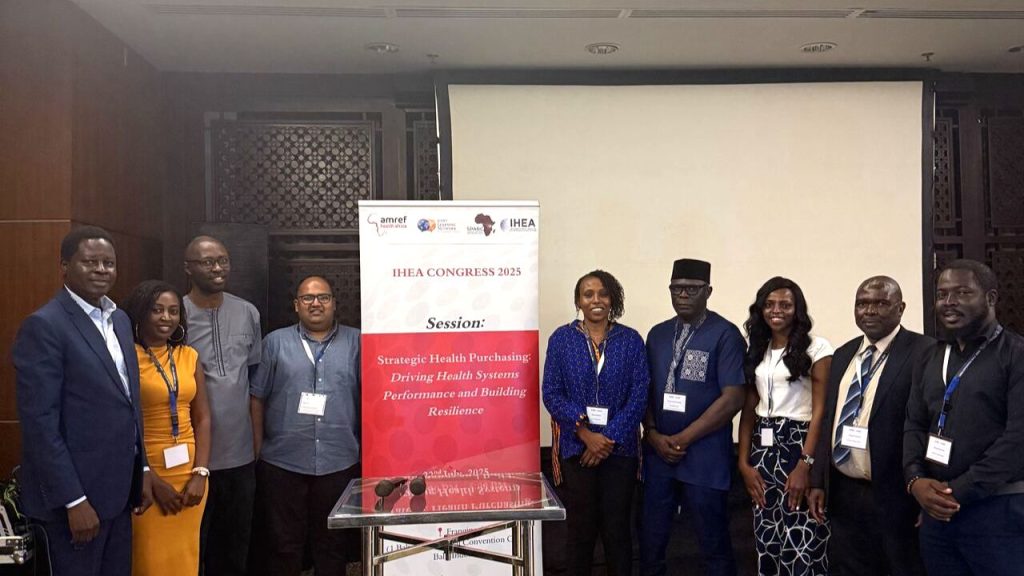
Africa faces a persistent challenge in financing healthcare, often characterised by limited public spending, high out-of-pocket payments, low domestic funding, and fragmented donor and funding flows. To tackle these challenges, countries are turning to Strategic Health Purchasing (SHP)—a smarter approach to delivering better health outcomes for every dollar spent, ensuring more equitable and accountable use of both domestic and donor resources. "Strategic Health Purchasing can improve how a health system uses information on population health needs and provider performance to more effectively allocate resources to health providers—even in fragile settings." - Boniface Mbuthia, Technical Director, Health Financing, Amref Health Africa

Latest Blogs